#01
Context
A risk check that lives where the work happens
Tierwise is a Jira app that tracks every AI system a team builds and how risky it is under the EU AI Act. It runs on Atlassian Forge, so there is no separate server and data stays in Forge storage. I built it to show how I think about AI governance, evals and product decisions in a real tool rather than a slide. It started from a Jira Marketplace app with a simple per-ticket risk questionnaire that I wanted to push further.
#02
Users & problem
Spreadsheets nobody opens after the first fill
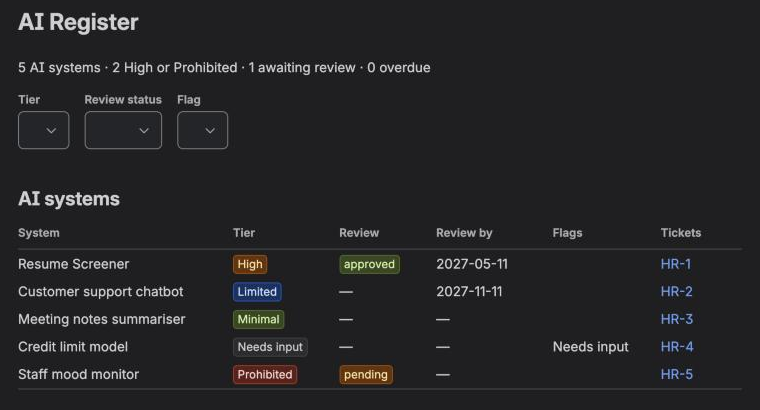
Most teams handle AI risk in a spreadsheet someone fills in once and nobody opens again, while the real work happens in Jira. The existing Marketplace app tracked tickets, not systems, so one model could be rated differently across tickets. Tierwise groups tickets into systems: the register gives each AI system one row with its tier, review status, review due date and linked tickets. Compliance reviewers approve the high-risk ones.
#03
Process & outcome
Tiering, eval gates and Jira-enforced sign-off
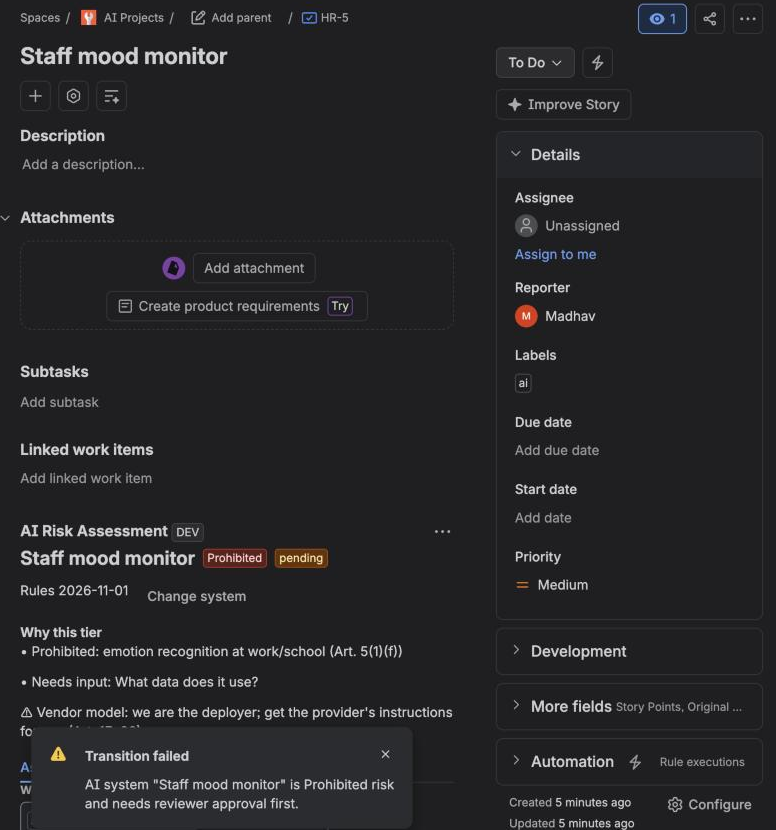
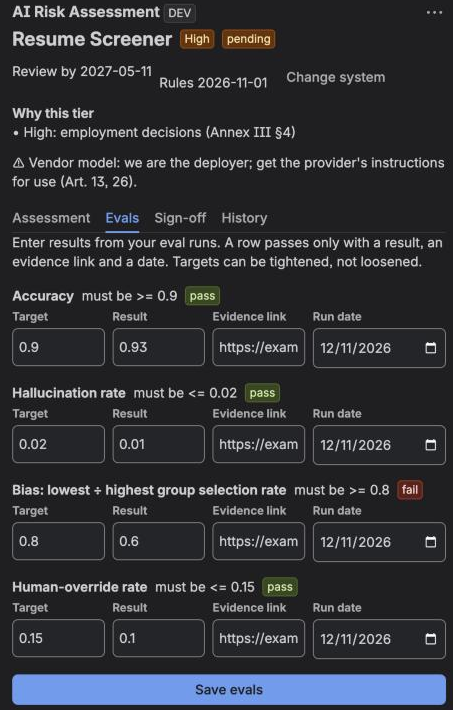
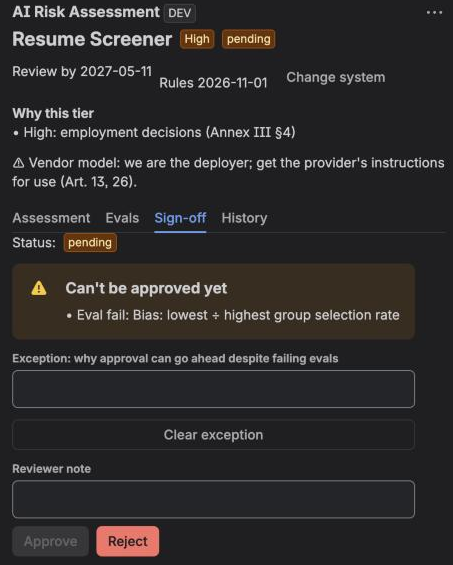
Answers map to Prohibited (Article 5), High (Annex III), Limited (Article 50), Minimal or Needs input, and the highest tier wins. High-risk systems need accuracy, hallucination, bias and human-override evals, each with an evidence link and date. In the demo a bias score of 0.6 fails a 0.8 target and blocks approval until it is fixed. Changes after approval trigger a re-review with full history. The rules sit in one file and 12 tests pass.
#04
Trade-offs
What I chose, and what I left out
01Track systems, not tickets
One model can touch twenty tickets. Rating each ticket separately ends with the same model rated three different ways.
02“Not sure” blocks progress
Better to surface a gap than let someone pick Minimal just to get past the form.
03Every tier comes with a reason
It names the article or annex behind it, so a reviewer can disagree with something specific.
04No AI autofill for the answers
A person owns the assessment. Autofill makes it too easy to click through.
05Better to do one regulation properly than several halfway.